
Fire safety contracting is one area where shortcuts have direct consequences. A system that looks installed but has not been properly designed, tested or maintained can fail completely in the moment it is needed most, with no warning.
If you have a project in hand and want a straight conversation about scope, timelines, and what a realistic MEP contract should look like, our team is happy to talk through it with no pressure to commit.
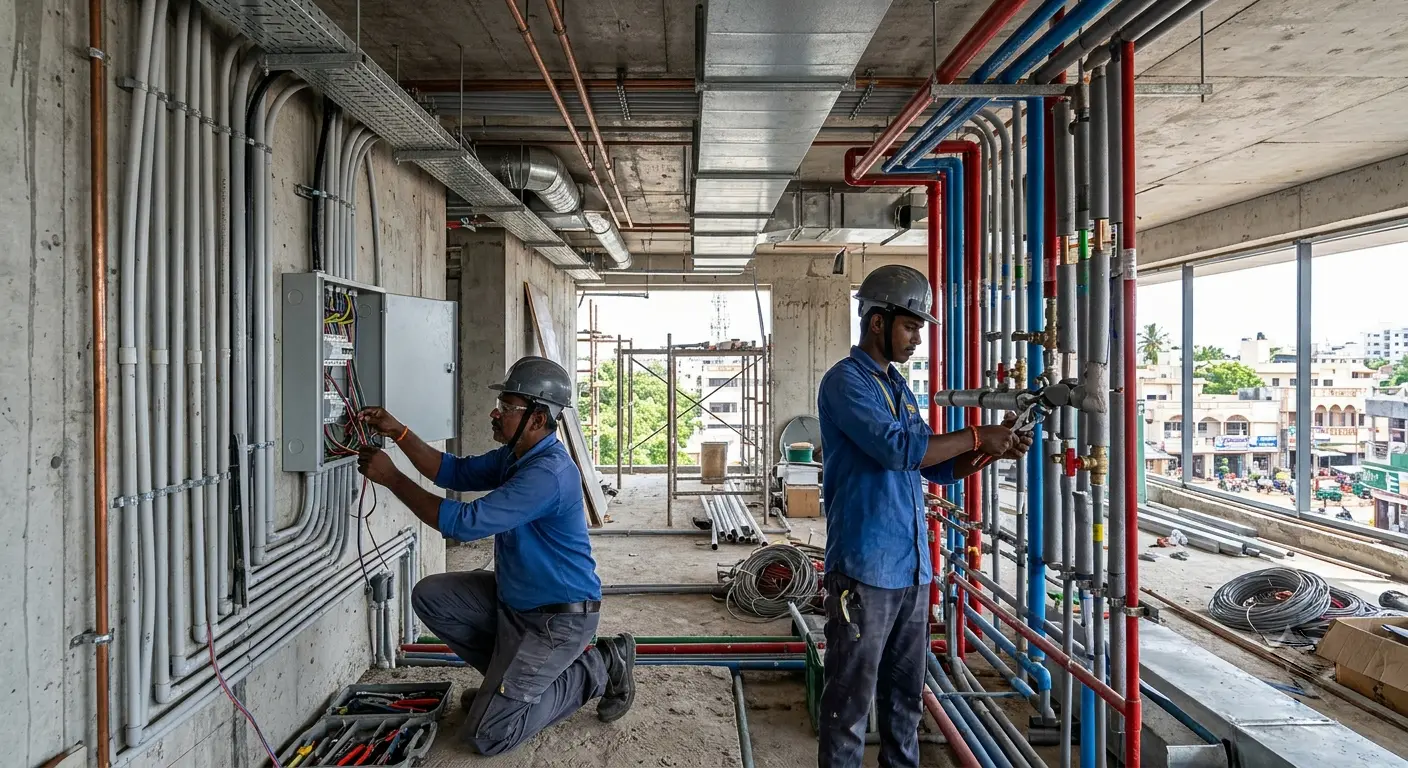
MEP systems are embedded inside walls, ceilings, and floors. Unlike furniture or finishes, you cannot easily swap them out if something is wrong. A poorly sized HVAC system, an undersized electrical panel, or plumbing that was never properly tested will show up as recurring problems that get more expensive the longer they go unaddressed.
Most of these problems are not visible during a site walkthrough. They become visible during the first summer, the first audit, or the first time a regulator asks for documentation that was never produced. Choosing the right contractor upfront is the only reliable way to avoid them.
The first question to ask any MEP contractor is whether they handle all four disciplines under one contract, or whether they subcontract parts of the scope to other vendors.
Some firms present themselves as full MEP contractors but actually handle only HVAC or only electrical, and manage the rest through subcontractors they have loose relationships with. This matters because coordination between trades is where most MEP projects go wrong. If your contractor owns the entire scope, they have no one to blame but themselves when something does not line up.
A genuinely turnkey MEP contractor handles HVAC, electrical, plumbing, and fire safety through their own in-house teams, coordinates the design of all four together, and is accountable for the final result across all disciplines. You can read more about what this looks like in practice on our turnkey MEP services page.
Many contractors in Chennai can install systems. Far fewer can design them properly. There is a significant difference between a contractor who installs based on a drawing someone else produced and one who does their own heat load calculations, electrical load analysis, and hydraulic calculations before recommending any equipment.
If a contractor gives you a quote without asking about your floor plan, occupancy, equipment load, or ceiling height requirements, they are quoting on assumptions. Assumptions in MEP design lead to undersized systems, wasted capacity, and compliance failures.
Ask specifically whether load calculations, single line diagrams, and coordination drawings are included in their scope, and whether they have MEP consultants in Chennai who work on the design side before installation begins.
Before collecting quotes from MEP contractors, it helps to have a clear picture of what scope you actually need. Our engineers can review your drawings and give you a checklist of what any contractor you evaluate should be covering.
A contractor experienced in residential apartments may not be the right fit for a factory. A firm that has done primarily retail fit-outs may struggle with the utility piping and heavy electrical loads of an industrial facility. MEP requirements are genuinely different across building categories, and experience in one does not automatically transfer to another.
Ask for specific project references in your building category, whether that is a commercial office, a hospital, a data centre, a warehouse, or a manufacturing plant. The contractor should be able to name completed projects of similar scale and talk through what the MEP scope involved. If they cannot, that tells you something important.
This is one of the most commonly overlooked factors in MEP contractor selection, and one of the most consequential. Good MEP work is not just well installed. It is well documented.
At handover, you should receive as-built drawings for every discipline, equipment operation and maintenance manuals, warranty certificates, pressure test records, commissioning reports, and panel schedules. Without these, your facility team cannot maintain the systems effectively, and any future contractor working on the building has to start from scratch to understand what is installed.
Ask the contractor directly what documentation package they provide at handover. A vague answer is a red flag.
An MEP contractor who installs systems but has no structured AMC offering is essentially handing you a problem. HVAC systems need quarterly servicing to perform efficiently. Electrical panels need thermal scanning to catch overheating before it becomes a safety issue. Plumbing pumps and STPs need scheduled maintenance to avoid breakdowns. Fire safety equipment needs regular testing to stay compliant.
The best MEP contractors in Chennai offer a single AMC that covers all four disciplines after installation, with scheduled visits, written service reports, and a documented trail that satisfies compliance audits. If the contractor you are evaluating cannot describe their AMC structure clearly, ask why.
This is the mistake that causes more post-project problems than any other. Two MEP quotes can look very different in price while covering completely different scopes. One may include design, BIM coordination, testing, commissioning, documentation, and AMC. Another may cover only installation labour and basic materials.
When comparing quotes, ask each contractor to itemise exactly what is included. Design and calculations, ducting and piping, cable trays and earthing, testing and commissioning, as-built drawings, and AMC should all be line items with a clear answer for each.
A quote that excludes commissioning, documentation, or AMC is not cheaper. It is just moving cost to a later date when you have less leverage.
Our team can help you build a standard scope comparison template so you are evaluating like for like. We can also provide our own itemised quote to include in your evaluation.
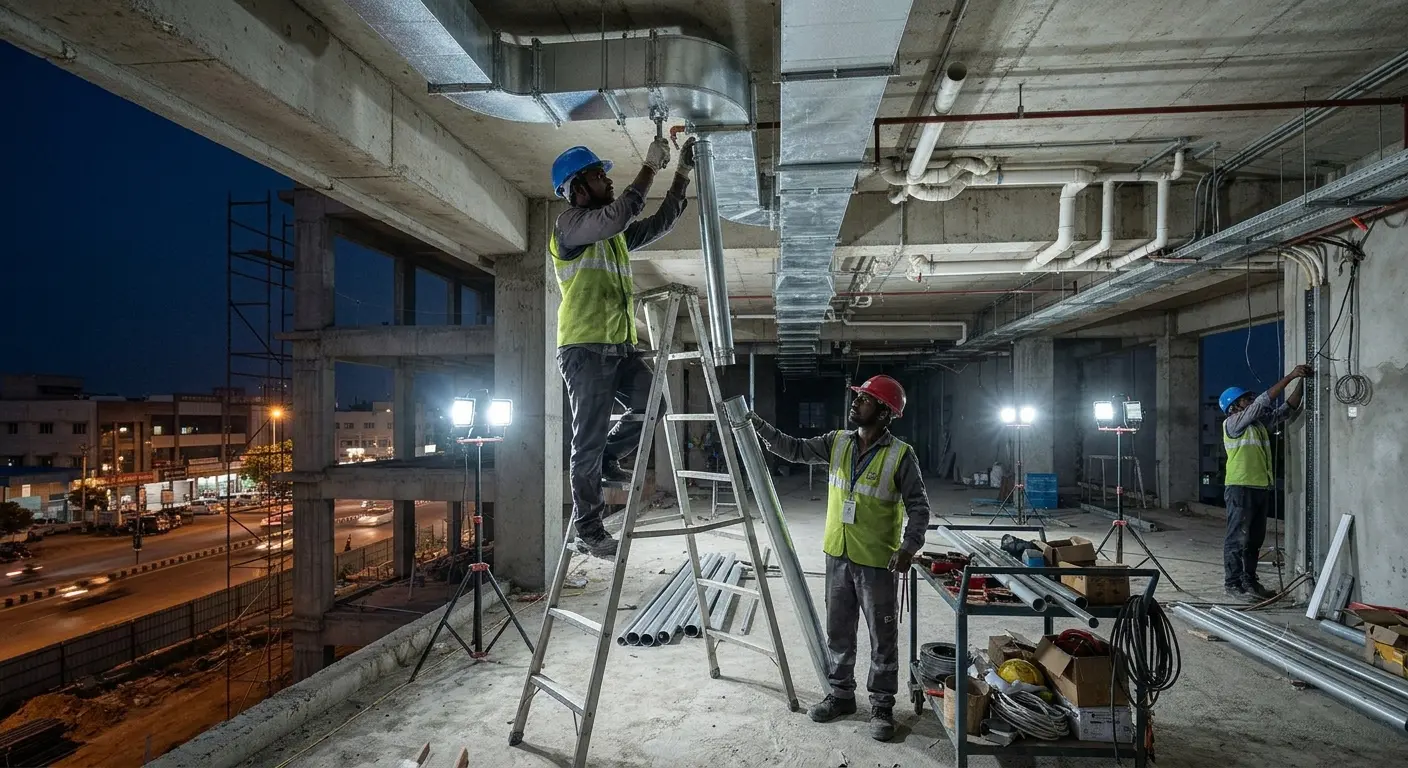
MEP work happens in the same physical space as civil, structural, interior, and facade work. A contractor who cannot coordinate professionally with the other teams on site will cause delays, disputes, and rework that affect everyone.
Ask about their site coordination process. Do they produce a detailed MEP installation sequence before work starts? Do they attend site coordination meetings? Do they flag clashes in advance rather than discovering them during installation? These behaviours are the difference between a contractor who finishes on time and one who spends the last month of a project firefighting.
To summarise, here is what a properly evaluated MEP contractor should be able to confirm before you sign anything. They handle all four disciplines under one in-house team. They produce their own design and load calculations before recommending equipment. They have completed projects in your specific building category that they can name and describe. They provide a full documentation package at handover including as-built drawings and commissioning records. They offer a structured AMC covering all systems after installation. Their quotes are itemised enough to compare scope, not just price. And they have a clear process for coordinating with other site teams.
Any contractor who hesitates on more than one of these points is worth evaluating carefully before committing.
Arrow Space handles the full MEP scope through in-house teams covering HVAC, electrical, plumbing, mechanical, and fire safety. Design and load calculations are done by our own engineers before any equipment is specified. We provide full as-built documentation and commissioning records at handover, and our AMC covers all four disciplines under a single contract after the project is complete.
You can review our full scope on our MEP services in Chennai page and our MEP consultants in Chennai page.
We are happy to be assessed against every point in this guide. Share your project details and we will provide an itemised scope, a timeline, and references from similar projects.
Fire safety contracting is one area where shortcuts have direct consequences. A system that looks installed but has not been properly designed, tested or maintained can fail completely in the moment it is needed most, with no warning.

Fire safety contracting is one area where shortcuts have direct consequences. A system that looks installed but has not been properly designed, tested or maintained can fail completely in the moment it is needed most, with no warning.
Fire safety contracting is one area where shortcuts have direct consequences. A system that looks installed but has not been properly designed, tested or maintained can fail completely in the moment it is needed most, with no warning.